
It’s not going to rain
When my husband and I got engaged, I knew immediately that I wanted to get married outdoors at my parents’ home. We asked what they thought, and they immediately said no. We proceeded to tour venue after venue in New Jersey and around Philadelphia, but none felt right. While it wasn’t my intention to wear them out and wear them down, that is what happened. When I asked again if we could please get married at home, this time their answer was yes.
From the moment of that yes, to the moment of my husband’s and my yeses under a flowered arch in their yard, my parents worried about rain. For eighteen months, they proposed a steady flood of ideas about what we would do if it rained on October 2. For eighteen months, my response was the same – “It’s not going to rain.”
I truly wasn’t being bullheaded (which I absolutely have the capacity to be). I simply refused to worry about it. Is a clear sky on your wedding day a miracle? If it is, I was expecting a miracle. While my parents were asking what we would do if things went wrong, I was asking, “What if everything works out?” And – honestly? – I 100% believed it would.
I’ve made an awful lot of Plan B’s
It’s been a long time since I planned my wedding. And, as I recently told this story to a friend, I realized it has been a very long time since I approached anything of magnitude with the attitude of “What if everything works out?” Instead, I spend an awful lot of my time and energy working out fail-safes and Plan B’s.
Why do I do this? Well, partly because I’ve been around the block more than a few times. I know that things go wrong, and when they do, it can be a stressful scramble to get them sorted again. In addition, because I’m a mom, I’ve spent the last two decades making sure that three other lives are running smoothly. I would do almost anything to avoid having to navigate more than one stressful scramble at a time, so I plan the heck out of everything just as my parents planned the heck out of my outdoor wedding.
Sure, being well-prepared for things to go wrong means I don’t really have to worry about whether or not I will be OK if things fall apart. But as I realize that this has become my steady state, I feel wistful for the version of me that believed for eighteen months without a quiver of a doubt, that my wedding day was going to be beautiful. I would like to downsize the part of me that feels vulnerable even just hoping for a miracle let alone expecting one. I would like to be willing to risk disappointment rather than be so busy constructing fall backs that I’m distracted from all the surprising ways that unexpected outcomes can be beautiful and life-giving.
Miracles take two to tango
I suppose I’m kind of hoping that it’s possible for the current version of me to expect miracles. I read somewhere (it was attributed to Origen, a Christian philosopher who lived in the first century A.D.) that a miracle “takes two to tango.” The divine must create the miracle and then, that miracle must be recognized. Obviously, the recognizing part is our job.
Here’s a curious thing: the more miracles you recognize, the more you will recognize. That parking space right up front? Miracle. The flower on your zucchini the very same day that bees start buzzing around your garden? Miracle. Those clean scans? Miracle. The fact that you and a friend who just annoyed you burst out laughing (the kind of laughter that has you doubled over with tears streaming) at exactly the same time? Miracle.
While these may not be the types of happenings classically considered to be miracles, when you recognize as miracles all the little ways that things work out – in other words, when you do your part – it becomes easier to believe that the divine is doing their part as well. Most importantly, when you get comfortable noticing all the little ways that things work out, it’s less of a stretch to believe the same could happen with the bigger stuff – a job search, a health scare, a tender, new relationship.
As I try to reconnect with the younger version of me who was so confident in her expectation of a miracle, I’m trying to notice myself making contingency plans and constructing fail-safes. When I do, I pause, take a deep breath, and ask myself, “What if everything works out?” Maybe it will. Maybe it won’t. But as I get from point A to point B, I think I’ll feel better for imagining that it will.
I told you it wasn’t going to rain
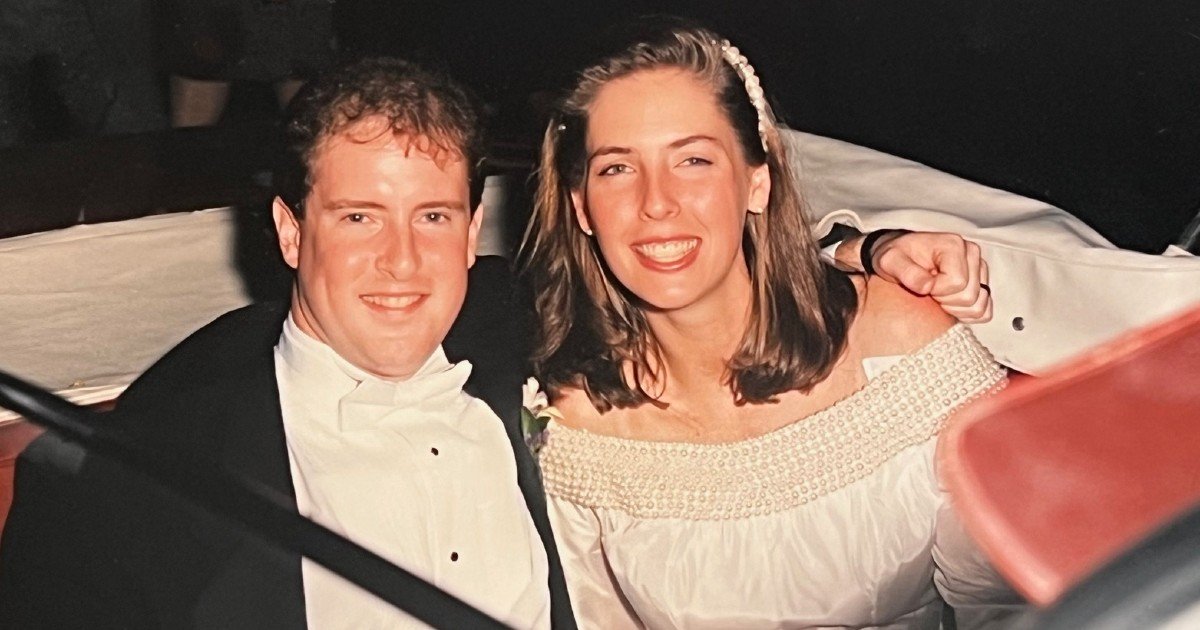
By the way, in case you’re wondering, October 2, 1993, was a glorious, blue-sky autumn day. We were whisked away from our wedding reception in a vintage red convertible with the top down and, as we stepped into our hotel, we felt the first drops of rain. Miracle? It sure felt that way to us. And, as we’ve learned, recognizing a miracle is half of what it takes to make it one.
Two of the most fundamental practices in yoga are steady practice (abhyasa) and letting go (vairagya). (See sutras 1.13-1.16) We are asked to let go of our desire for particular outcomes of our steady practice. In the case of miracles, just because I’m steadily expecting a miracle doesn’t mean one will turn up. But if I’m not expecting a miracle, I am less likely to recognize one – especially an unexpected one – when it does.