
I’m not much of a “handy-gal”
I have a girlfriend who I’m a little in awe of. She can do anything! No tool is beyond her. Fuse box on the fritz? Give her a call. Wish you had a sprinkler system in your yard? She’s your gal. Need to patch a plaster wall? Just give her a second so she can read up on it, and she’ll be right over.
I’m not like my friend. Though I pride myself on being an excellent putter-together of Ikea bookshelves (which sometimes requires using an electric drill, I might mention), until this past week, that was the extent of my handiness.
Not anymore.
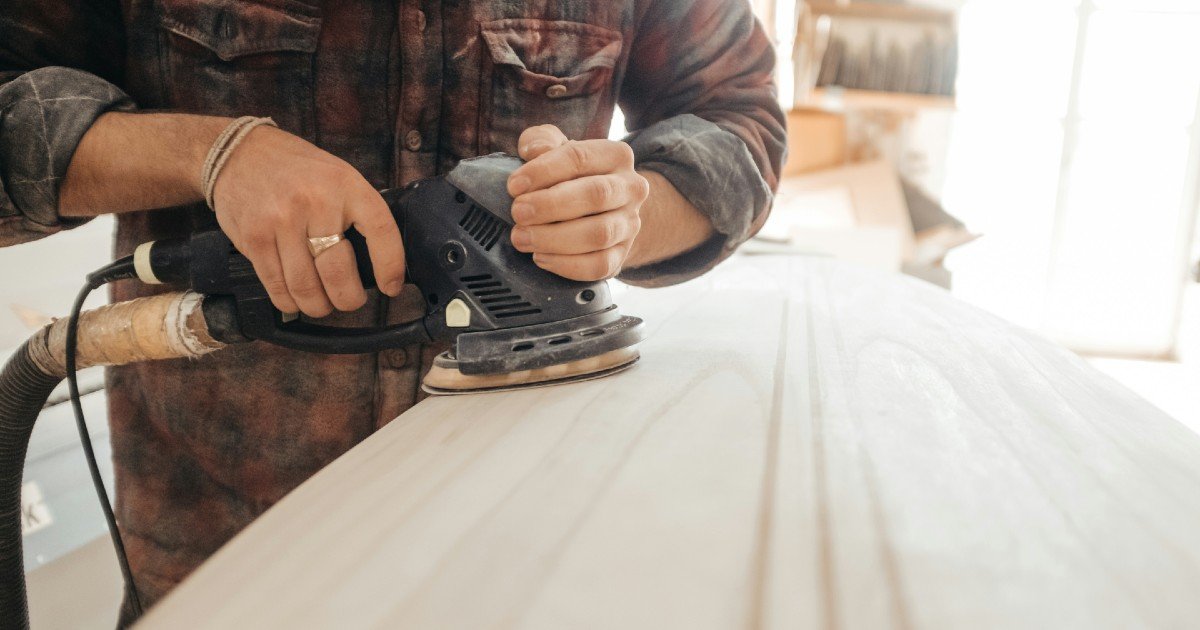
I now know how to use an orbital sander! Like, really really well. This week I sanded fourteen pieces of teak patio furniture. Twice. Once with a rougher grain and once with a finer grain. Plus, not only do I know what that means, but I can determine when to change the sanding pad and do so (to quote my middle child when she was three years old) ALL BY MYSELF.
Oh my lord, do I love it. It is soothing, satisfying and completely engaging. I’m not sure a single thought other than, “Look – just look! – at the lovely way that the golden teak-ness of my patio furniture shines through the gray patina of weather and age,” in the hours and hours that I sanded.
A little handy-er and a little happier
I almost missed out on this idyllic project. Perhaps because of my aforementioned lack of handiness, my husband assumed this was a job that fell squarely into the “blue” rather than the “pink” column of our task list. When I realized that, it took me a second to figure out why I was so disappointed. It turns out that a project where I could see results was highly appealing to me. And every single slat of every single chair and side table was an opportunity to see immediate and beautiful results.
I didn’t realize how rare this has been in my life lately. When I teach a class or write an essay, I may walk out of the classroom or away from my laptop thinking, “that went pretty well.” But it’s fairly unusual (and extraordinarily special) to be allowed a clear glimpse of why my work mattered.
This is even more true of the work that has mattered most to me in the last several years – walking with various loved ones through medical challenges. To even call this “work” feels vaguely wrong. It involves a lot of waiting. The tasks required can be tedious and tiny – checking portals, making appointments, making lists of questions. It is really less about doing and more about simply being available and present.
Life is less about results and more about taking the next right step
Crossing a proverbial finish line is rare in any of the work I do. An essay can take me a week to write. The course I teach lasts for 14 weeks. With caregiving, it is definitely best not to even think of an end date. Upon reflection, most of the work that I devote myself to is about taking the next right step, and then the next next right step. Which is the nature of life, by the way.
Human nature yearns for resolution. When we’re in a time of challenge, our instinct is to hunker down until it’s over and life goes back to normal. When we’re in a sweet time, a tiny part of us is on edge lest it end. But it’s all life. Whether we’re at our most heartbroken or most terrified or most elated, life asks the same thing of us. It asks us to live. It asks us to take the next step, and the next, and the next.
Staying in the moment is the key
The key to not getting overwhelmed is to stay fully focused on this one step that life is asking you to take. Just this step. Not getting through this crisis, this month, this week, or this day. Just this moment. We can survive anything if it’s just for this moment. We get ourselves in trouble when we allow our minds to shoot ahead into the future and think thoughts along the lines of, “I can’t do this for that long,” or “What if this doesn’t last until then?”
Spiritual practices such as yoga and (it turns out) sanding porch furniture are designed to hold us in the moment. When we practice, we experience the relief of being absorbed in exactly what we are doing right when we are doing it. We experience a peace that is ridiculously hard to find most of the time – the peace of a quiet and settled mind. We experience the satisfaction of being exactly where we are – body, mind, and heart.
By the way, make sure to enjoy those finish lines that you do get to cross!
Though all of these are incentive enough to do them, practices like these (and, by the way, I’m sure you have your own version of sanding furniture) offer one more gift. They scratch the very real, and very human “itch” of wanting a finish line to cross; of desiring to see the results of your work.
My new skill with an orbital sander is not likely to change anyone’s life. But, man-oh-man, it sure changed a few days for me. Somehow, I sense that the satisfaction I felt, standing there covered head to toe in sawdust having sanded the very last chair, will be fuel for the real work I do as I walk forward – step by step – into today and (though I’ll try not to get ahead of myself) tomorrow and the tomorrow after that.
There is a concept in yoga called nishkam karma, which is translated as desireless practice. When we’re practicing nishkam karma, we do what we do without clinging to a desire for particular results or any result at all. Which is not to say that a particular result such as seeing your old furniture transformed by sanding doesn’t feel really, really good. It does. Yoga gives us a glimpse of the truth that doing things with less obvious results can also feel good. Which is a very healthy lesson for all of us humans to learn.