
What are you hoping to see today?
As we got settled onto the boat that would take us deep into Northwestern Fjord in Kenai Fjords National Park, the naturalist for our trip, Jack, worked his way around the group asking us what we were hoping to see. My family and I looked at one another and one of us said, “Whatever is out there we would love to see!” Jack smiled and said, “But is there something specific? Like the birders in the front of the boat are hoping to glimpse the red-faced cormorant and the parakeet auklet.”
The birders got lucky and spotted both these birds and more, but I wonder if we felt even luckier than they did because we didn’t embark with a list of specific animals that we wanted to see. In fact, any list I could have compiled would either have been pretty sorry because I’m not well-versed about the birds and creatures of Alaskan waters, or it could have set the bar way too high risking disappointment.
As it turns out, we loved seeing both the expected and the unexpected equally. It was clear before we left the dock that we would see more bald eagles than we imagined possible, and every one was a joy to behold. We had read that there was a good chance we’d catch a glimpse of puffins and knowing so did not make them any less endearing silly to watch.
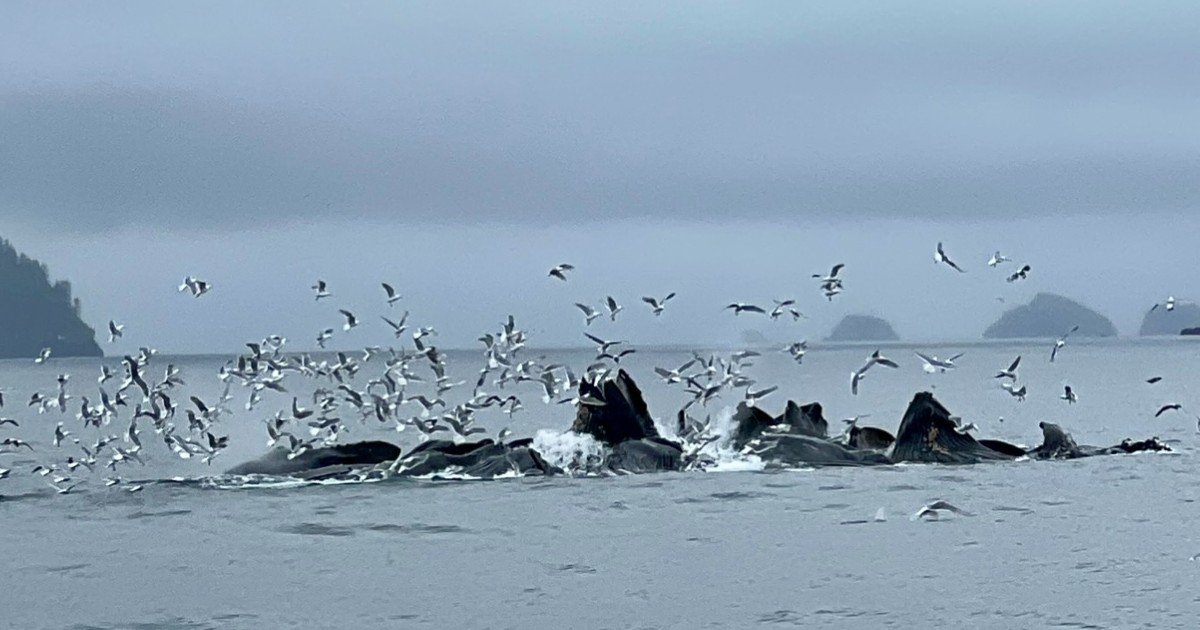
We were awed to see a pod of sixteen humpback whales performing the highly choreographed cooperative feeding technique known as bubble netting. This was a marvel, until that day, I didn’t know was a thing! Even if I had known about it, I think I would have felt a little audacious asking Jack to add it to his list! Seeing it all, the expected and the unexpected, left the five of us awash in gratitude.
We’d love to see whatever is out there!
You don’t need to travel all the way to the Kenai Fjords to set aside your wish lists and allow the world around you to offer its gifts. In her poem I Didn’t Think to Ask for Woodcocks (excerpted), Ann Bodling[1] describes a similar experience in her very own yard.
I didn’t think to ask for woodcocks
or the red fox
or the marlin in the front yard
and the fox sparrows in the back
or the tundra swans
or the bald eagle who sailed through the yard
with prey clasped in its talons.
…
For all I didn’t think
to ask …
Thank You.
I disembarked from the boat after our tour deeply grateful for all we’d seen – and I think I felt that gratitude most keenly “for all I didn’t think to ask.” For me to have created a list of things I wanted to happen that day would have limited my experience within the Kenai Fjords. I might have been so busy hunting for an orca or a tiny feathered murre that all I saw instead would have felt incidental rather than the whole, complete experience that it was.
Letting go of expectations allows you to be grateful for it all – expected and unexpected
While my family and I did not do so on purpose, showing up to our Fjords cruise without a wish list was a great experience of how powerful it can be to approach life with openness and curiosity about what might happen; with a willingness to see how things will unfold. This approach can feel more natural when you’re in a new place or when you’re experiencing something for the very first time like you do when you’re on vacation.
It can be even more powerful to set aside your wish lists and expectations for the way things are going to go or what you’d like to happen when you’re closer to home. When we manage to do so, even in our own yard, even in our own messy, day-to-day life, the sweet gifts that we notice can leave us feeling just as awash in gratitude. Which inspires us to wonder with anticipation, just as we do when on vacation, “What could happen next?”
In the Yoga Sutras of Patanjali, the yamas are taught as principles of self-regulation that help us to change the habitual patterns that our mind develops in its misguided attempts to find security in the world. (See YS 2.30.) The final yama is aparigraha or non-possessiveness (YS 2.39). If we can consciously step back from our desire for and attachment to desired objects or outcomes, we find that we are free to gratefully embrace life exactly as it is right now.
[1] You can find more of Ann Bodling’s writing on her blog, Earthy Blessings