
All yoga classes end in rest
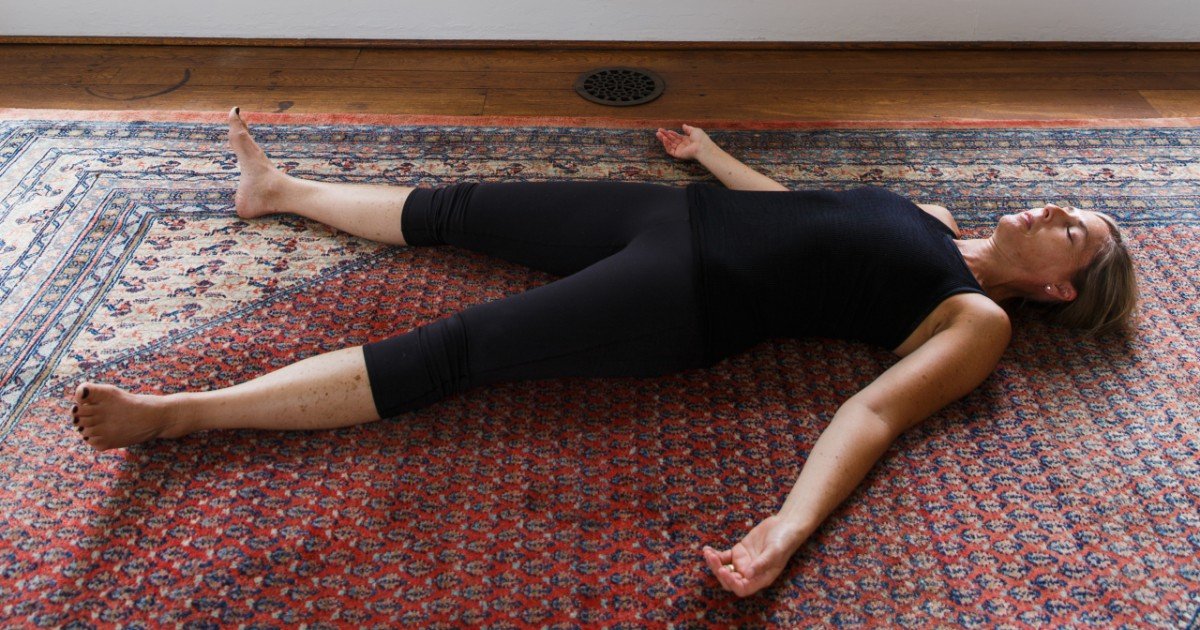
Have you ever taken a yoga class? If not, I’m going to spoil the ending. At the end of the class, your instructor will cue you to lie down on your mat to “take rest in savasana.” By the way, savasana is translated as corpse pose, so they are serious about the quality of the rest – we are to be as restful as the dead.
At my very first yoga class, I was relieved and stunned in equal measure when I heard this instruction. Relieved because I was physically exhausted – I felt like a wrung-out sponge. Stunned because I had never even considered lying on the floor with a bunch of people I didn’t know. And stunned that, in the moment, this seemed like a very excellent idea.
I remember that first rest in savasana as feeling heavenly. There I was, mother of three children under the age of five. I had walked into class nervous and exhausted in the worst possible way – already tired at 9:00 am and facing an uphill slog of caregiving that would not end for 10-12 hours. I’d ended class exhausted in the best possible way – with the invitation to give my exhausted self exactly what she needed for a few minutes. Ahhhhhh.
That rest can be hard to achieve
In the years (decades) since, I’ve discovered that the purity of that first savasana can be elusive. It’s easy to talk my body into “taking rest.” I’ve learned how to find and release little pockets of holding or tension that hide in my body – in my jaw, hands, forehead, and lower back. A series of little squeezes and releases and I’m as soft as a noodle for a few minutes.
My mind, however, is a different story. As my body relaxes into the floor, as my breath and heart rates slow, my mind often takes off. I can find myself assessing my practice, planning the rest of my day, adding items to my grocery list, making a list of people I need to text, reciting that list over and over again so I don’t forget after I sit up, wondering if I have rested enough, wondering what time it is, wondering if I should just sit up now and get on with it. Good Lord.
This is clearly not the rest of the dead that the name of the pose implies that we’re seeking. This is as busy as one can be without moving one’s body. In fact, I’d say that this kind of busyness feels worse than busily doing something because it lacks the focus and attentiveness that I feel when I’m engaged in an activity. This mental churn is exhausting and ineffective.
Rest both requires and teaches us to be present in the present
Worst of all, it is wholly disengaged with the invitation being offered – the invitation to rest in the present moment. Everything churning around in my mind is luring me to the past or to the future. If my experiences in these hectic and disturbed savasanas have taught me anything, it is that neither of these “places” on the timeline of life are restful. Rest requires full engagement in the present moment. The reverse is also true – full engagement in the present moment is the only way to find rest.
My body knows how to be present better than my mind does
When I catch myself lying on my yoga mat with a churning mind, I have learned that I can invite my awareness to join my body on the floor. I can choose to be where my body is. When I decisively step away from my thoughts and drop into physical sensation, I can feel everything – my head on the mat, my belly rising and falling, my skin cooling. When I pull this off (and I cannot always do so), the relief I feel is even more powerful than the relief I felt in my very first savasana.
Leaving behind the chaos of my mind feels as if I’ve managed to escape a crowded, noisy, overwhelming room and dropped into the most spacious, quiet space imaginable. “This,” my body seems to say. “This is the way it’s meant to be.” And I trust her. My body’s response – relief – feels true. It feels like the highest possible intention.
In savasana, when we can step away from our minds and join our body in the present moment, we encounter our own embodied knowledge. This is knowledge that often gets overlooked because we weren’t taught it, we didn’t study it, and we didn’t earn it. It’s always been ours, but most of us have to discover it.
Practicing rest convinces us to trust the knowledge of our body at least as much as we trust our very knowledgeable mind
Connecting with our embodied knowledge over and over again at the end of our yoga practices cultivates our trust in the cues of our body. We learn to recognize and respect our feelings – whether they’re of overwhelm or relief. We learn to honor the truth that activity is sustainable only when balanced by a little hard-core rest. We learn to seek moments off our mats – when we’re moving through our days – when we can feel that full engagement with exactly what is happening that we feel when we manage to find rest in savasana.
When you make time for rest, everything that needs to get done will get done – and you will feel better as you do it
I know the chaos and churn of our minds are reflections of the chaotic and churning world around us. I know that every single day each of us faces lists and lists that scream for our attention. I know that it is more typical than not to feel squeezed for time. I also know that regularly taking savasana (including those hectic ones), even when you’re really, really pressed for time, is a way to cultivate your ability to BE in the time you have at that moment. It is a way to train yourself to just be present, even for just a few minutes.
So, what do you say? Feel like joining me on the floor? Remember to set a timer so you don’t have to wonder about when to stand up. That way, all you have to do is be. And when you do stand up, you will be refreshed, renewed and reinvigorated. I promise.
Tantric yoga teacher and translator of the Yoga Sutras, Alan Finger, describes the greatest gift of yoga as its ability to teach us to be in the now. This is, he says, how we’re meant to be. When we experience pure awareness in the Now, we are experiencing a taste our true essence. “Tada drastuh svarupe vasthanam” YS 1.3
Photo credit to the very talented Bill Ecklund.