
I would love to look in the mirror and smile at what I see
When I was ten or eleven years old, I remember sitting on the bed watching my beloved grandmother stand in front of the mirror to put on her lipstick and her monogram brooch. I don’t remember where we were going. She, in the way of all Memphis women of her generation, was “put together” no matter what we were doing.
She said to me, “I wasn’t always an old lady, Amy Lou! I was beautiful!” Then she took one more look at herself in the mirror and patted herself on the chest with a satisfied smile. I remember thinking, “I think you’re beautiful now, Nanny,” and, judging from the way she smiled at her reflection, I bet she would have agreed.
I want to be like her. I want to look in the mirror and smile at what I see. Yet, I’ve realized over the last little while that my body and I are not in such a good place. Again. This feels particularly bad because the peace I had made with my body years ago did not come easily.
The roots of self-image run deep
My story is not unusual. Like so many women, my relationship with my body was formed as much by my mother as by myself. I grew up the daughter of a woman who was very concerned with appearance and who struggled with her own body. As I moved into adolescence and adulthood, I was always too thin or too fat in her eyes. As much as I yearned for her to stop sharing her opinions about my body with me, I also desperately yearned to be deemed “just right.”
My mom controlled her body by controlling what she ate. She taught me to do the same. Well into my adulthood, she was as fixated on what I was and was not eating as she was on what she was and was not eating. At the end of a day together, she could (and often would) list for me everything I’d eaten that day as I rustled about for an afternoon snack. This list never once made me feel good.
I know what being friends with my body feels like
The first time I remember being at peace with my body was the year after my wedding. Living with a man who simply ate when he was hungry – and even sometimes when he wasn’t – was terrifying at first. “What would he think if I ate all of that?” “Would he love me if I got fat?”
But he wasn’t watching my intake at all – in fact, he was happiest when we were eating together – and as our first anniversary approached, not only did he still love me, but I still fit into my clothes! I heaved a sigh of relief about more than just the size and shape of my body. Thanks to my husband, I had found some freedom within my relationship with food for the first time in memory.
I found yoga in the wake of giving birth to our three kids. Thanks to my practice, the peace I’d made with my body and with food deepened into friendship. My body made me proud of what it could do rather than what it looked like. More importantly, my body was integral to the practice that centered and stabilized me mentally, emotionally, and spiritually. My body and I were one.
The fact that I just typed the word “were” instead of “are” breaks my heart. I am stunned to realize that I feel almost as much conflict with my body now as I did before I got married. I thought I’d kicked this! Thanks to the sudden and dramatic changes that my body is exhibiting because of menopause and the effects of 58 years on the planet, I find that I am once again at odds with my body. I am once again uncomfortable in my own skin. This time, though, I know what it feels like to be my body’s friend, and I want to feel that way again.
The philosophy at the heart of yoga offers a way back to peace
I trust that the practice that initially brought me into friendship with my body will, with time and practice, be able to guide me back. Yoga philosophy offers three tenets that will, I pray, help. The first is ahimsa, or non-violence[1]. When I catch myself thinking something critical about the menopause middle that continues to surprise me daily, because of my practice, I know I need to replace that thought with its opposite – something loving, or at least kind. I will confess that I’m still struggling to find kind words that also feel honest about that area of my body, but I am learning to lay my hands gently on my belly and to consider that as an embrace of sorts. Baby steps.
When I notice how studiously I am avoiding the mirror, I know I need to stand there for a moment and really see myself – the way I watched my grandmother gaze at herself. Not looking is dvesa – avoidance or aversion.[2] My avoidance of my reflection is not freedom. It is wishing something (me!) were other than it is. By developing a practice of looking at myself I am practicing acceptance. While I cannot honestly say that I always love what I see, I am learning to see some beauty within and beyond the changes. More baby steps.
Finally, yoga teaches that abhinivesa or fear of death is the cause of human suffering that is hardest to navigate.[3] I think my current discomfort with my aging body is a symptom of this suffering. The changes I see in my body are a daily reminder that I am aging and aging only goes in one direction. Not to sound dramatic, but it is harder to ignore the reality of my eventual death now than it was in my twenties!
It is not surprising to discover that I am locked in a struggle with abhinivesa. Yoga lore contains stories of yogis who were so advanced that they could walk on hot coals, levitate from their mats, and even tell the future, but who could not reach true freedom because they remained afraid to die. Which is all to say that I know it’s not realistic to think that I’ll ever be able to completely check this one off my to do list.
I want to be my body’s friend once again
Even though I may never reach that final frontier of acceptance, my practice has given me the tools to age more mindfully than I currently am. With steady practice and some time[4], I trust that yoga can help me reach a peaceful acceptance of the changes and effects of getting older. As it does, I suspect it will also free me from some of the suffering I’m causing myself by fighting what is happening.
Then, I will stand in front of the mirror as my grandmother did (even though I rarely wear lipstick and never wear a brooch). Then I will look at my reflection and remember the blushing bride and glowing young mother I once was. And also to see the beauty in who I am now. Then I will smile with satisfaction at the worthy and precious woman I am today – menopause middle and all.
This will be so much bigger than a baby step!
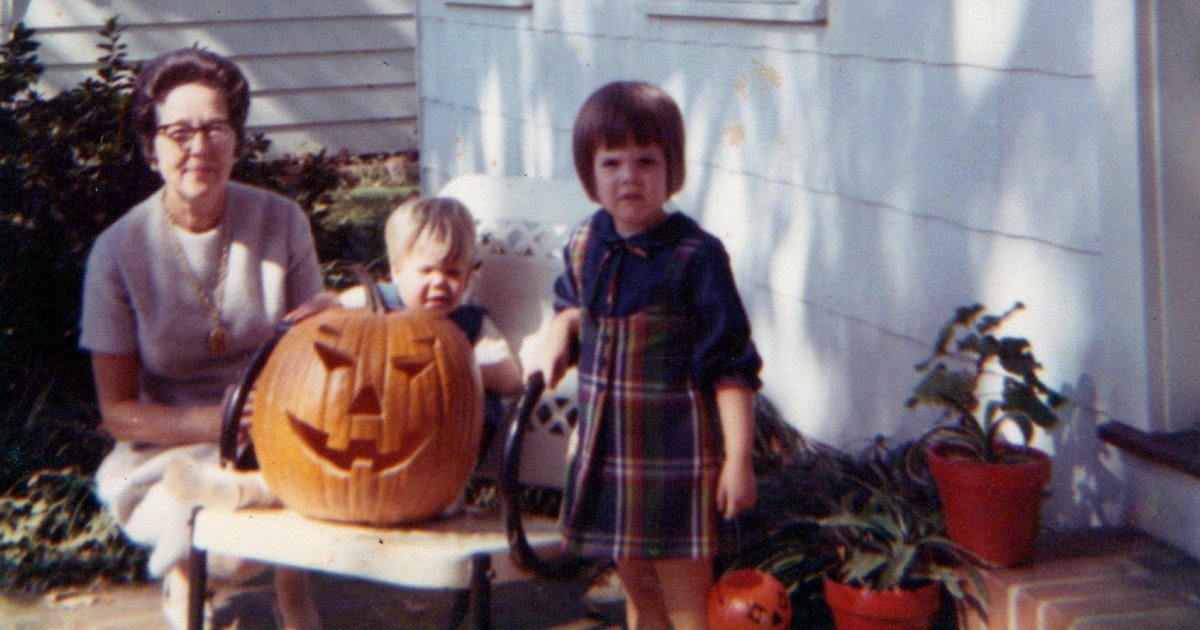
PS The photo is of my grandmother looking beautiful after an afternoon making Jack-o’-lanterns with my baby brother and me.
[1] Bhavani Maki writes in her commentary on the Yoga Sutras, The Yogi’s Roadmap, that one who is aligned with non-violence (YS 2.35) stimulates friendliness in others. A practice of non-violence extends also to ourselves. Imagine how good it could feel if all hostilities were abandoned between you and your body!
[2] Yoga sutra 2.8 teaches that a feeling of discomfort – including discomfort within our own skin – is immediately followed by a sense of aversion.
[3] Maki writes about YS 2.9, “even the wise sage (or, for our purposes, crone hahaha) has an innate inclination to cling to life.” This clinging is revealed when we cling to vestiges of earlier stages of life like a flat belly or unlined face.
[4] Yoga sutra 1.14 teaches that yoga needs to be practiced steadily over a very long time to bear fruit. I trust that similar patience and persistence will be asked for in this new stage of my practice.