
A deep dive into family history yields a deep understanding about the nature of life
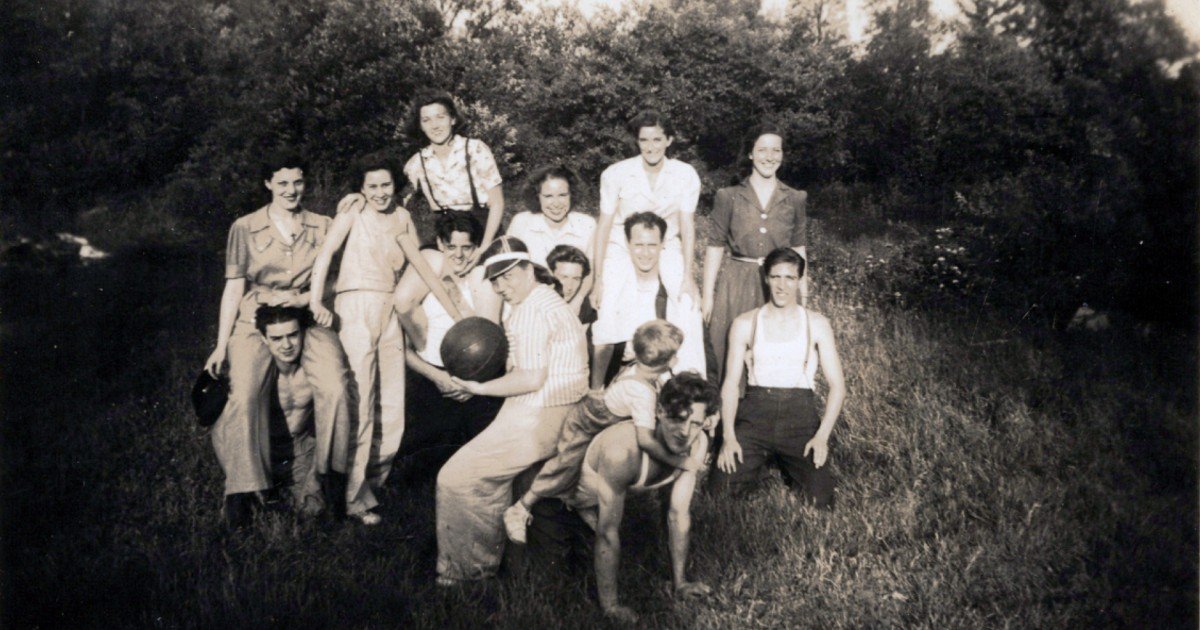
When my mother-in-law died a year and a half ago, I became the custodian of tubs of photos documenting my husband’s family from the 1920s through the mid-1990s. It’s been an on-going labor of love to organize and then scan the images so that our kids and their kids (and maybe even our grandkids’ kids!) will be able to know who these faces are one day when we’re gone.
Looking at these pictures one by one has been an intimate process. It’s felt like I am dropping into life stories of other people – some stories that I never had the privilege of hearing and some that I thought I already knew but now know at entirely new depths.
The one constant in the stories these photos tell is that life is made up of love and heartbreak, of joy and struggle, of births and deaths. Not one of these life stories was graced with only good. Not one was one long stretch of bleakness. Life, the stories of my husband’s family have taught me, is not an either/or situation. It is a matter of both/and – for all of us.
Doesn’t yoga help make life easier?
For a longer time than I care to admit, one of the driving reasons that I practiced yoga so diligently was that I believed to the depths of my soul that it would help smooth out my life. That it would be a refuge from all that was hard for me. I would not get so angry, so sad, so frustrated, so confused … you get the idea. Instead, I would be serene, poised, even (to use an adjective I learned from reading yoga texts and thus craved to become) equanimous.
In hindsight, it seems silly that I clung to this belief for so long. After all, my physical yoga practice wasn’t all peaches and cream. I was challenged by postures I craved to be able to do but wasn’t yet ready for; by injuries and illness; by days where my spirit was willing, but my flesh was weak. In other words, I confronted the both/and-ness of life on my yoga mat right out of the gate.
Nope. But it will help us get better at living our life.
Nevertheless, it was a bit of a blow when it finally dawned on me that yoga was not going to change my life off my mat any more than it had eliminated challenges on my mat. “Stuff” was still going to happen. I was still going to get angry, sad, frustrated, and confused. Thanks to my practice, however, I began to see that I had more resilience. I had more patience with myself. My anger, sadness, frustration, and confusion ceased to define who I was, and became simply ways I was feeling.
The blow of understanding that life was going to continue to be life was, however, softened by another realization. It also dawned on me that the sweet moments of life were not sailing by without my awareness quite as often. While I’d always noticed the pinnacle “highs” of life – birthdays, successes, wins – my practice was teaching me to savor the little moments – a call from a friend, the hopeful anticipation of finding a late-in-the-season bud on my rosebush, the satisfaction of dropping into my bed after a full day.
All this sweetness was filling me up, making me better able to navigate the less-than-sweet parts of life. Without any conscious effort, it was as if my yoga-induced heightened awareness of the good in life was making it easier for me to trust that, even when I am in the throes of a challenge, “this too shall pass.” Better yet, no matter what was going on, I found that there was also always something to savor in this life of mine, no matter how tiny.
We can’t have the good without the bad, but we can feel more peaceful with it all
I feel deeply grateful for the honor of being allowed to dive into a hundred years of photo stories from my husband’s family. They have given me a long view of the moment-by-moment awareness I have developed in my yoga practice. We cannot have love without loss, we cannot have success without failure, we cannot have joy without sorrow, we cannot have light without darkness. What we can have, though, is a sense of peace as we ride the ride of life through it all. That peacefulness, it turns out, might just be what the word “equanimous” means – and now that I understand it better, it is even more alluring.
In Yoga Sutra 2.15, Patanjali teaches that when we develop clarity from our yoga practice, we start to understand that any life experience can cause suffering – even the good ones. It is not the experience itself that is the issue. It is our reaction to it. Our reactions cloud over the clarity we have gained and throw us back into suffering.
In the following sutra, YS 2.16, Patanjali teaches that suffering that has not yet happened can (and should) be avoided. I read this to say that our yoga practice gives us the space we need to embrace the “ups” and not resist the “downs” of life. In other words, our practice leads us to an inner equanimity that frees us from suffering no matter what we’re experiencing.