
Twenty-two happy days
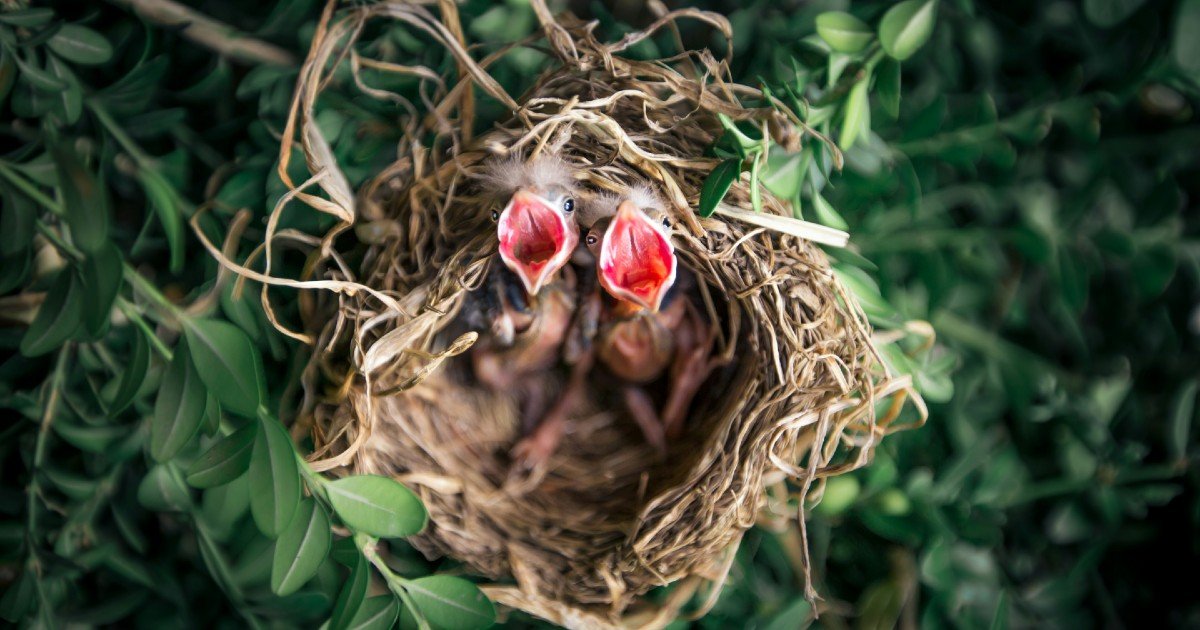
Twenty-two days is how long it took for the bird’s nest in my holly tree to go from full to empty. It was an amazing and joyful experience to have a front-row seat to the beginning of new life.
Fullness, when you’re talking about a nest, is an apt word. Three tiny, bright blue eggs. The nearly constant presence of one full-figured mama bird and the full days work of one slender papa bird continually coming and going for ten days.
Then eleven days of babies. Two babies taking the full journey from impossibly small and helpless to rather boastfully preening their new feathers. There were days full of naps under mama’s soft belly and snacks delivered tenderly by papa and, surprisingly, one “uncle.” There were even two days of that awkward stage between cuteness and “glow-up” that reminded me of the middle school years, which I suppose, rounded out the full infant->childhood->adolescent->transformation.
Surprising were the two full days of independence when the babies were on their own in the nest alternately snoozing and looking around while mama and papa hunted, gathered and supervised from a nearby branch. We humans do it the other way round. Somehow it felt a little kinder for these feathered parents to leave their little ones to learn to be on their own in the safe space of their nest.
When happy things come to an end, it is sad
Day twenty-two fully stopped me in my tracks. I checked on the babies on my way to my yoga mat to find there was only one in the nest and felt tears fill my eyes. How could this be? Where did he go? Was he alright? I said to my daughter, “I wasn’t expecting heartbreak!”
When I passed the nest after practicing, it was empty – fully empty. How can a nest look like a ghost town? I don’t know, but this one did. That said, the absence of the second little bird filled me with optimism that both babies were OK. Even though they were still so small, and their feathers so new, the time had come for them to move on from their nest. I wish I knew how mama and papa knew it was time. I wish I knew how they convinced their babies to take that first leap.
Twenty-two days is enough time to re-learn a life lesson
These twenty-two days, it turns out, did more than allow me to viscerally relive my parenting journey in stop-motion. Twenty-two days was also enough time to simultaneously witness one of yoga’s most challenging and powerful principles, aparigraha or non-possessiveness (YS 2.39), and experience the discomfort that arises when you cling greedily to a nice thing that is happening in your life.
When you break the Sanskrit word aparigraha into its component parts, you get a deeper understanding of the word’s meaning. “A-” means “not,” “pari-” means “to fill,” and “graha” means “one’s dwelling place.” Patanjali is teaching us not to hoard in both the dwelling place of our home and our consciousness. In her translation of this sutra, Bhavani Maki writes that aparigraha is a non-possessive attitude that allows us to keep life as uncomplicated and clutter free as possible.
Mama and papa bird (if you’ll allow me to anthropomorphize them for a moment) embodied aparigraha as they gracefully moved to a nearby branch to give their children the space to stretch toward independence. How many of us human parents are able to provide such space when our children first show signs of needing it? It can take years (which, admittedly, would probably be mere hours in the condensed life journey of a bird) before we even recognize that the annoying behaviors of our offspring are a plea for such space!
The pain of an ending is worth it. The pain of resisting an ending is not.
More importantly for my own continued growth was my experience of the pain that comes when we are not practicing non-possessiveness. I cannot tell you how many times I interrupted a happy moment at my window watching life happen before my eyes, to preemptively mourn the day that the babies would fly away. By not wanting the happy thing to ever end, I threw shadows over moments of pure joy.
It all comes down to how you enjoy things
The beautiful thing is that my experience of my own clinging taught me to find the sweet spot between enjoyment and fear of that enjoyment ending. Aparigraha, it turns out, has a lot to do with how we appreciate something. Can we do so wholly even as we know that this, like everything in life, will change and end?
This is not easy. It goes against the way we’re hardwired. But, with practice and mindfulness we can do it. We can even do it when what we’re appreciating is something more treasured than a bird’s nest in our window. No matter who or what we are loving, doing so with the spaciousness of non-possessiveness allows us to sink deeply into the joy and also to go gracefully with the flow – allowing an ending with faith that every ending is inevitably the beginning of something new.
The sadness we feel at an ending is a reflection of the happiness we felt before it ended
This doesn’t mean that endings won’t hurt. The sadness I felt at the sight of the empty bird’s nest was a reflection of the joy I’d received from it for twenty-two days. That said, practicing non-possessiveness asks us to be as open-handed with our sorrow as we are with our joys. In my case, I needed to be careful not to cling to my wistfulness that my time with “my” nest had ended. Otherwise, I could miss out on what would come my way next.
Which, by the way, was a glimpse of papa bird hopping along the shrubs in front of our house with a worm in his mouth. I smiled happily imagining him feeding his youngsters tucked safely into the shrubs while they learn to hunt and gather on their own.
Aparigaha is the absence of greed and possessiveness. It is created when we understand that we can have things, but we don’t own them. If we can consciously step back from our desire for and attachment to our stuff (and the things we love), the desired object or outcome things holds no power over the ego, and the things that we want and have can’t own us. – YS 2.39 as translated by Alan Finger