
When someone is gone, everything and anything can be a reminder of their absence
Our cat, Lola, died quite suddenly last week. She was weaving between my feet and purring loudly from her bed next to my desk before I left for work and, ten hours later, the five of us were taking turns holding her one more time at the vet. Our house is entirely changed without her. There is no place I can go where I don’t expect to see her. Everywhere is a reminder of her absence.
I cannot walk into my bedroom where my cat will never again be on the corner of the rug in the sunbeam without feeling a knot in my throat. And this isn’t true only of my cat. I get an ache in my chest whenever I arrive at our family lake house and am reminded (again) that my brother will never again be here with me. My mother-in-law’s birthday was three days after Lola died – our third without her. Now the first week of September is an even bigger reminder of those who are no longer here.
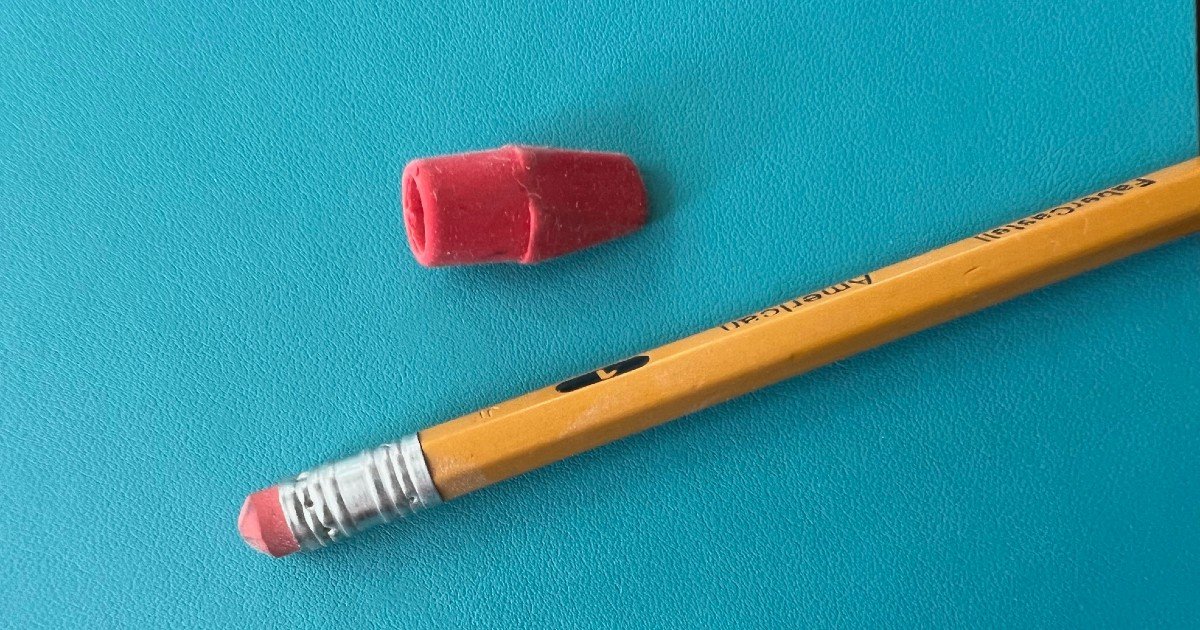
In this way, death feels like an eraser.
Death adds a layer of meaning to things that were not that meaningful before
Erasers don’t only remove. They leave things behind. And, like those little pink shreds left all over on my math homework when I was learning my times tables, what is left behind in the aftermath of death is impossible to avoid and clingy.
I cannot drive past an Applebee’s (do you know how many of these there are?) without feeling wistful as I remember dozens of mediocre meals shared with my family in a place where the ruckus of my mom’s dementia was mostly well-tolerated. And Sunday dinners still feel poignant; they are a reminder of the weekly dinners we shared with my mother-in-law for years after her diagnosis.
Death changes the way you live
As good as they are at erasing, erasers don’t just remove. They change what is left behind. Think about a pencil drawing instead of a math problem. When you use an eraser, you change the image.
In the wake of death, I am still standing. I am still here, but I am not at all the same. I did not escape the heartbreak and anguish of loss, but am, somehow, learning to live with it. I can have the time of my life dancing the night away or spending a perfect day at the beach with old friends and still ache for those who are no longer here to enjoy moments like this with me.
Even in the happiest of moments, my tears are near to the surface. In fact, I believe my heightened feelings help me feel joy and silliness even more keenly. This is very different than how I’d imagined “feeling better” would feel. Perhaps, a better description would be “living better.”
Are my lost loved ones living on in me?
Because of death – because of all that has been “erased” – I am here and I am different. I am feeling more. I am participating more fully. I am observing more passionately. I am (trying to be) more patient and accepting of all of it. I am living more caringly.
If all of this is true (and it is), then I have to wonder if death is an eraser after all. Nadia Bolz-Weber writes,
“Maybe all the love, creativity, hilarity, solace, and tenderness that we’ve ever known – every belly laugh, every whispered secret, every late-night road trip with bad gas-station coffee, every hand we’ve held in both joy and grief – maybe all that is not actually gone. Maybe it ends up forming the connective tissue in our lives, invisible but strong, like the ligaments that keep our bones from flying apart. … if you’re still standing, it might not be because you’re strong. It might be because you are held together by the love you’ve received and even by the love you gave, whether or not you knew what the hell you were doing at the time.”[1]
Perhaps, because their deaths changed me almost as much as their lives did, my lost loved ones are still leaving a mark on the world through me? Is this how it goes? Is my living on – both laughing and crying, both dancing and mourning – how those I loved and lost live on?
I don’t know, but it sure feels good to remember that because I feel their absence I am remembering they were here and that I love them. It sure feels good to know that not only do I carry them with me, but that their love makes me strong enough to do so.
In the yoga sutras, we learn that desire (as in how badly we wish that our lost loved ones were not gone) and aversion (as in how hard we may try to hide from our pain that they are gone) (raga and dvesa, taught in YS 2.7 and 2.8) are two sides of the same coin. Both states cause us to suffer. The antidote to this suffering is to stay in the moment – allowing both love and pain to exist in our lives. Living with loss reveals the fullness of life and our capacity to live well with the anguish of having loved and lost.