
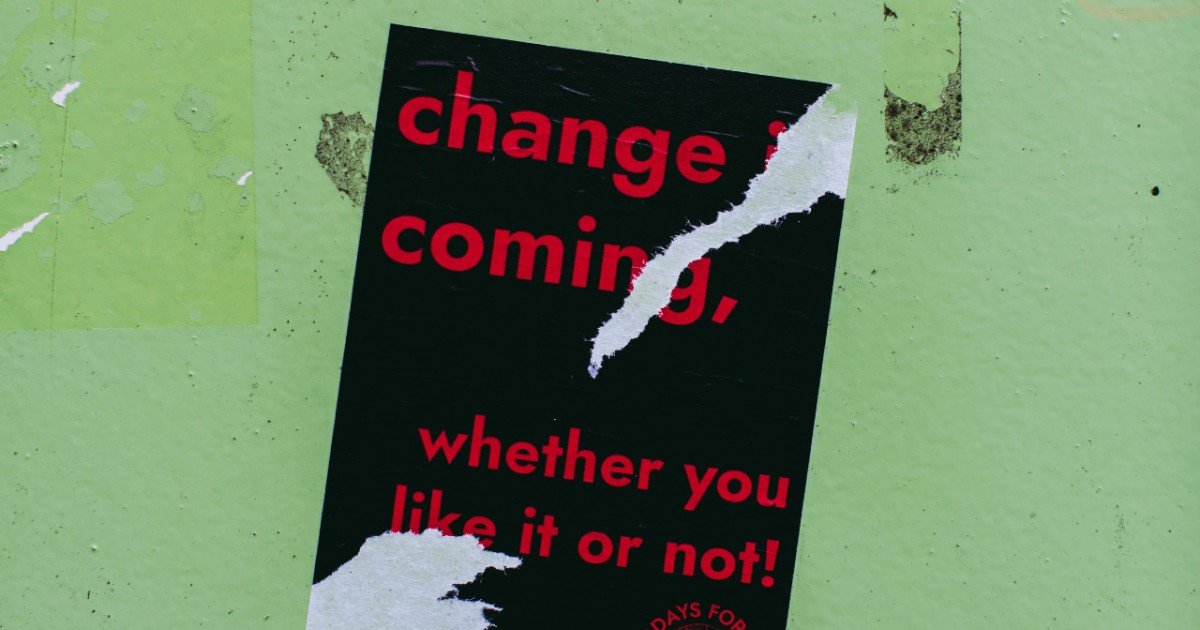
Change comes in many shapes and sizes
“If you fear change, leave it here.” – sign on a coffee shop tip jar[1]
There are countless types of change. The slow-motion change of your round, sweet-cheeked babies morphing into lean, lanky adolescents. The sudden change of illness or death. Inevitable change that you dread such as (at least for me) college graduation. Highly anticipated change such as the birth of one of those sweet-cheeked babies or a hard-sought promotion.
Whether expected or sudden, whether anticipated or dreaded, change challenges us enough that many (most!) of us fear it. Many of us would like, as Robin Wall Kimmerer quipped after sharing the above quote, to deposit some of the changes we are currently navigating into a tip jar and leave them for an unsuspecting barista.
Change is inevitable and resistance to it is futile
Because we can’t drop that kind of change into a jar, we’re going to have to learn to live through it. It turns out we can learn how from one of the earliest and simplest forms of life on our planet – moss. Kimmerer, in her book Gathering Moss, writes about mosses that “acceptance is their way of being. They earn their freedom from the pain of change by total surrender to the ways of [life].”
This line hits me very deeply. I have experienced an extraordinary amount of change in remarkably quick succession over the last seven years – a personal health scare invited me to a new relationship with my yoga practice and my body, three huge losses reshaped the once-familiar landscape of my family, burnout forced me to slow down and reconsider the pace of my professional life.
Knowing myself, if I’d faced any of these changes on their own, it is more than likely that I would have resisted and fought. Thanks to the power of hindsight, I can see that my resistance would have, in the immortal words of Star Trek, been futile. Worse, my resistance itself would have made the changes I was experiencing more painful.
Sometimes we reach acceptance because we are simply not strong enough to resist
Because of the relentless nature of all this change, I truly had no choice but to accept what was happening. Life had brought me to my metaphorical knees. Humbled by my inability to do more than take the next right step, I began to sense the surprising freedom that comes from total surrender.
Within surrender we can find the space for renewal
Moss, Kimmerer writes, is entirely dependent on water. For them a “drought” can be as short as a few days or as long as 40 years. When the water they need dries up, “they shrink and shrivel while carefully laying the groundwork of their own renewal.”
In dry and challenging times, times when there is no way for a moss to go on, the moss shrivels in on itself. But this shrinking does not lead to death. It is not a weakness. The moss folds in on itself to patiently await change – for the dry spell to be broken by a little rain.
I read that and smile. I see that I, much like a moss, shrank and shriveled a bit over the last seven years. I see that this was self-preservation. I see that while, in weak moments, over the last few years I have felt a little ashamed that I could not “do more” or “be more,” my shriveling was exactly what needed to happen. In fact, it might have had a touch of simple moss-like genius about it, because while I was shrunken and a bit shriveled, like moss I was laying the groundwork for my own renewal.
Though we may “shrivel” during times of change, it is still possible to thrive
A moss doesn’t choose to “do” what it needs to do as it patiently awaits the end of a dry spell. It simply does what mosses have done for millennia when the water dries up. Similarly, I didn’t choose to do what I needed to do in my own dry spell. As I folded inward to endure the onslaught of change, I instinctively leaned on the practices that I have tended steadily for two decades. The acceptance, resilience, patience and persistence that have rooted into my very being from years of steady practice, equipped me to not only survive the last seven years, but to quietly thrive.
Finding a deep gratitude for change
Whether my long season of change will continue or has come to an end, I can sense myself, like a moss reunited with water, stretching and re-greening again. While it may be jarring for you to read this, as I count my blessings this Thanksgiving, I find myself deeply grateful that life brought me to my knees. I am thankful that this time in my life showed me, as studying moss showed Robin Wall Kimmerer, the power and grace that are mine when I “lay aside resistance for the promise of becoming.”
No matter the kind of change you are navigating, I pray that you, too, will be able to set resistance aside and choose acceptance. For this is the path of freedom and growth. It is in this way that we will stretch toward the promise of all we can become.
Happy Thanksgiving to you and yours.
Patanjali teaches that resistance (dvesa) is one of the five causes of human suffering. When we can let our resistance go, we are better able to quiet our minds and find moments of clarity and peace. YS 2.8
[1] Gathering Moss: A Natural and Cultural History of Mosses by Robin Wall Kimmerer, p. 35